

3 Questions HVAC Buyers Ask AI Before Requesting a Quote (And What Businesses Should Do About It)
How HVAC businesses can answer buyer questions about repair costs, replacement and technician availability before a quote request.
What if your next customer has already researched the repair, compared replacement options and decided how soon they need help before you ever hear from them?
Imagine a homeowner whose air conditioner stops cooling. They ask an AI assistant what repairs might cost, whether replacing the unit makes sense and how quickly a technician can help. Each question reveals a different decision they’re trying to make.
AI marketing for HVAC businesses starts with understanding those decisions. You can use them to write useful service pages, match ads to customer needs and give people a clear next step.
What is conversational search intent?
Conversational search intent is what someone is trying to accomplish when they ask a natural-language question. A short search like “AC repair cost” gives you a topic. “My air conditioner is 12 years old and isn’t cooling. Should I repair it or buy a new one?” gives you context about the equipment, the problem and the decision.
These questions are illustrative. Someone researching a repair may still be gathering information, so judge lead quality by what people do next.
1. How much will my AC repair cost?
Buyer stage: Awareness. The homeowner wants to know whether they might face a small repair or a major expense. They may ask what affects repair prices, whether the diagnostic fee is separate or how an estimate is prepared.
Explain the factors that can change the quote, such as the type of fault, equipment condition, parts availability and labour. Publish your diagnostic fee and what it covers if you have a set policy. Clarify which details require an onsite assessment before you can quote.
- Landing page section: Understanding AC Repair Costs.
- Trust signals: Technician qualifications, authentic reviews and a clear explanation of the diagnostic process.
- Call to action: Book an AC Diagnostic Inspection.
2. Should I repair or replace my AC?
Buyer stage: Consideration. The homeowner wants to weigh repair costs against the price and potential benefits of a replacement. Use a comparison to explain the factors your technician will assess.
| Factor | Repair | Replacement |
|---|---|---|
| Upfront cost | Often lower | Usually higher |
| Equipment condition | May suit an isolated fault on an otherwise reliable unit | May suit a unit with recurring failures or poor performance |
| Energy use | Depends on the existing system and fault | May improve depending on equipment, installation and usage |
| Warranty | Depends on the work and parts | Depends on the equipment and installer |
| Long-term value | Depends on remaining service life and future repairs | Depends on total installed cost and expected use |
ENERGY STAR’s replacement guidance lists equipment age, frequent repair needs and rising energy bills among factors to consider. These are discussion points for an assessment. Avoid pushing a higher-priced option without evidence that it suits the homeowner.
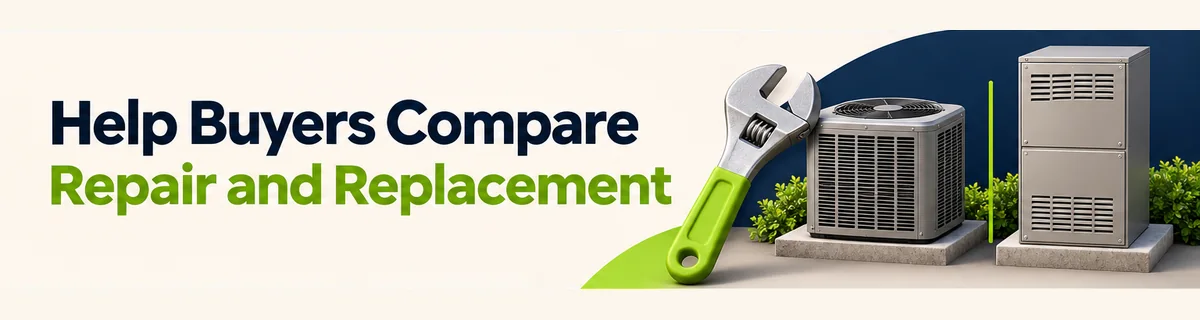
- Landing page section: Repair or Replace Your AC?
- Trust signals: Verified project examples, clear warranty terms and documented assessments.
- Call to action: Request a Repair vs Replacement Assessment.
3. How soon can an HVAC technician arrive?
Buyer stage: Decision. A homeowner may want to know whether technicians serve their area, how urgent visits work and when someone can confirm an appointment.
Put service areas, contact options and booking instructions where customers can find them quickly. If you offer same-day service, state when it is available and how customers can confirm it. Use accurate response-time expectations.

- Landing page section: Check HVAC Service Availability.
- Trust signals: Current service-area information, booking policies and verified contact details.
- Call to action: Check Available Appointments.
Match HVAC advertising to the customer’s question
“Professional HVAC Services. Contact Us Today!” tells someone what you do. “Repair or Replace Your AC? Compare Your Options Before Spending Money” gives a homeowner weighing those options a clearer reason to visit. Test each message against a matching page and compare qualified enquiries and booked jobs.
For an example of how a marketplace tested conversational advertising, see my Angi ChatGPT Ads case study for HVAC and local trades. If you’re planning a paid test, use the ChatGPT Ads setup and budgeting guide to check eligibility, targeting and measurement.
Build an AI-ready HVAC customer journey
- Research real questions. Review sales calls, customer enquiries and search data for recurring concerns about costs, repairs, replacements and scheduling.
- Build pages around those decisions. Explain how quotes work, what an assessment includes and where you can send a technician.
- Match the message and next step. Use educational messaging for research, comparisons for evaluation and booking options when customers are ready to act.
- Route enquiries accurately. An AI receptionist or enquiry workflow can collect basic service details and route requests for review. Use confirmed information for prices and appointment availability.
- Measure business outcomes. Track qualified quote requests, diagnostic appointments, booked and completed jobs, cost per qualified lead and cost per booked job. See the guide to measuring ChatGPT Ads through booked jobs.
Three ways to apply this to an HVAC business
These examples illustrate possible workflows.
- Repair enquiry routing: Collect equipment type, service location, the reported problem and a preferred appointment window. Route the enquiry to the service team for confirmation.
- Repair versus replacement qualification: Ask about the equipment’s age, reported faults and service history so the technician has context before the assessment.
- Quote follow-up: With the homeowner’s permission, follow up after an estimate, answer common questions and invite them to ask for clarification.
Answer the question before asking for the sale
A quote request may come after the customer has thought through cost, compared options and checked availability. A useful HVAC marketing strategy gives people a clear answer and a realistic next step at each point.
Ready to improve your HVAC customer journey? Tell me about your business, email hi@zainababdullah.tech or message me on WhatsApp at +92 331 6944411.