
When Should a Local Service Company Invest in ChatGPT Ads? A Practical Guide for 2026
Decide when to test ChatGPT Ads based on service-area coverage, spare capacity, existing campaign performance and cost per booked job.
Your business needs paying customers. When is a new ad channel worth a share of your budget?
Imagine a plumbing company with profitable Google Search campaigns, technicians who have room for more jobs and a carefully managed budget. ChatGPT Ads offers another place to test an offer. Before moving spend, work out whether the channel can bring in additional customers you can serve at a cost the business can afford.
What are ChatGPT Ads?
ChatGPT Ads are sponsored placements in eligible ChatGPT experiences. Someone asking whether to repair or replace an air conditioner may be comparing options. A homeowner searching for an emergency plumber may need to book immediately. In either channel, assess lead quality based on the service, location and next action, not on the question alone. See the ChatGPT, Gemini and Claude advertising comparison.
Four questions to ask before funding ChatGPT Ads
1. Can you reach people inside your service area?
Check advertiser eligibility, category rules and the locations your account can target. OpenAI documents subnational controls for some campaigns and markets, with restrictions depending on the account and campaign type. Check your actual options in Ads Manager before budgeting. A plumber serving Dallas needs enquiries the team can fulfil. See OpenAI’s campaign setup guidance.
2. Do you have capacity to take on more work?
Check technician availability, response times and scheduling capacity. An HVAC business might use a test to fill quiet weekdays. A plumbing company with a two-week wait may get more value from improving scheduling than from paying for more enquiries.
3. Can you test while protecting profitable campaigns?
If Google Search already delivers profitable jobs, set a separate test budget if the business can afford it. A company spending $3,000 a month on profitable search campaigns might set aside an additional $300–$600 for an experiment. These are hypothetical figures. Verify your account’s budget requirements and use the first ChatGPT Ads test guide to plan the cap and review dates.

4. Do you know your target cost per booked job?
Divide ad spend by confirmed bookings attributed to the campaign. If you spend $600 and record six confirmed bookings, your cost per booked job is $100. To decide whether that is viable, account for job value, gross margin, cancellations and other acquisition costs. See the guide to tracking ChatGPT Ads through booked jobs.
ChatGPT Ads vs Google Search Ads for local businesses
| Factor | Google Search Ads | ChatGPT Ads test |
|---|---|---|
| Customer intent | Can capture explicit searches for a service | Can reach people researching or comparing options |
| Local reach | Review location and radius controls where applicable | Verify available markets and settings in your account |
| Budget decision | Protect campaigns already generating profitable work | Use a controlled test budget |
| Success measure | Profitable booked and completed jobs | Evidence of additional profitable work |
Both channels can play a role. Use Google Ads location targeting guidance and the current Ads Manager controls to compare what each campaign can reach.
Attributed bookings and additional bookings
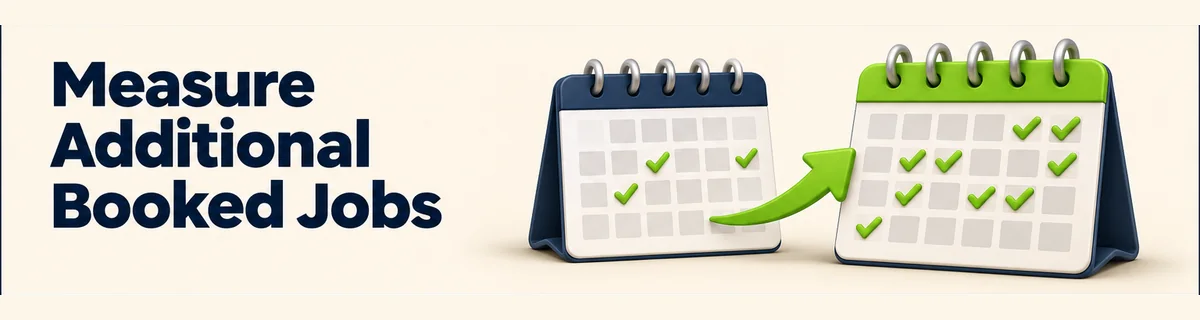
If eight of 15 enquiries become confirmed bookings, you can report eight attributed bookings under your chosen attribution rules. Some of those customers may have booked without the campaign. Incrementality estimates how much additional business the advertising generated. Compare against a suitable baseline, account for seasonal changes and use a controlled test where practical. Treat simple before-and-after comparisons as directional evidence.
How to run a smarter test
- Confirm eligibility and service-area coverage.
- Record baseline leads, bookings, acquisition costs and revenue.
- Set a spend cap and success threshold based on qualified leads and booked jobs.
- Keep profitable acquisition campaigns funded.
- Match the ad to a dedicated landing page and connect enquiries to the CRM. See the EV charger landing page guide for a service-specific example.
- Track qualified enquiries, bookings, cancellations and completed work.
- Review whether total profitable jobs increased after allowing time for bookings to mature.
Three illustrative business scenarios
- HVAC team with spare capacity: Test one offer for quieter weekdays if targeting can reach the company’s service area.
- Fully booked plumber: Improve scheduling and capacity before buying more demand.
- Cleaning business with unreliable tracking: Connect incoming enquiries with booking records before adding channels.
These scenarios describe possible decisions. They do not describe completed client projects.
Use automation to follow the lead
Automated enquiry routing, booking reminders, CRM updates and reporting can help a team respond consistently and see which leads turned into work. Keep human review in place for pricing, service eligibility and availability when those details need confirmation.
Give the channel a clear job to do
A ChatGPT Ads test earns more budget when you can reach customers you can serve, handle the extra demand and measure profitable work. Keep the experiment small enough to protect the rest of the business and clear enough to learn from it.
Want to make your advertising budget work smarter? Tell me about your business, email hi@zainababdullah.tech or message me on WhatsApp at +92 331 6944411.